Alan Turing
Father of Computer Science & Artificial Intelligence
Alan Mathison Turing was a British mathematician, computer scientist, logician, cryptanalyst, philosopher, and theoretical biologist. His groundbreaking work laid the foundation for modern computing and artificial intelligence, forever changing the course of human history.
"A man provided with paper, pencil and rubber, and subject to strict discipline, is in effect a universal machine."
— Alan Turing
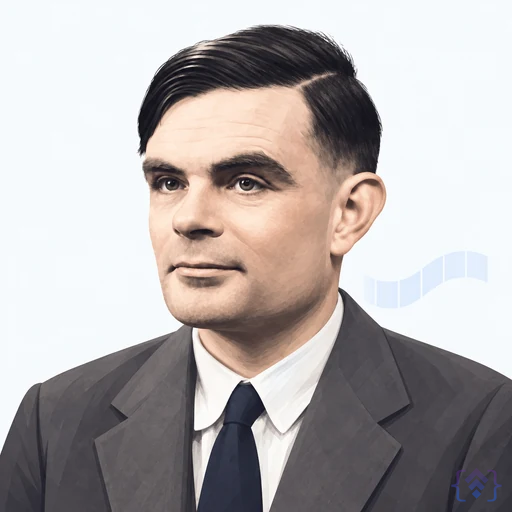
Birth & Childhood (1912-1926)
Alan Mathison Turing was born on June 23, 1912, in Maida Vale, London. From an early age, he showed remarkable mathematical abilities and an intense curiosity about how things worked. His parents recognized his genius but were sometimes puzzled by his unconventional thinking.
Sherborne School (1926-1931)
At Sherborne School, Turing's passion for mathematics and science flourished despite the school's emphasis on classics. He formed a deep friendship with Christopher Morcom, whose death in 1930 profoundly affected him and may have influenced his later work on the nature of consciousness and computation.
Cambridge University (1931-1934)
Turing studied at King's College, Cambridge, where he graduated with first-class honors in mathematics. In 1935, at just 22 years old, he was elected a fellow of King's College for his dissertation proving the central limit theorem.
Princeton University (1936-1938)
Turing studied for his PhD at Princeton under Alonzo Church. During this time, he published his most famous paper, "On Computable Numbers," which introduced the concept of the Turing Machine and laid the theoretical foundations for computer science.
Turing was openly homosexual at a time when homosexual acts were illegal in the United Kingdom. In 1952, he was prosecuted for homosexual acts and accepted chemical castration as an alternative to prison.
This persecution had a devastating impact on his life and career. He died on June 7, 1954, from cyanide poisoning in what was ruled a suicide, though some have questioned this conclusion.
In 2009, British Prime Minister Gordon Brown issued a public apology on behalf of the government for the appalling way Turing was treated. In 2013, Queen Elizabeth II granted him a posthumous royal pardon.
Beyond his mathematical genius, Turing was an accomplished long-distance runner who nearly made the British Olympic team in 1948. He had a best marathon time of 2 hours, 46 minutes, 3 seconds.
He was fascinated by biology and chemistry, conducting experiments in his spare time. In his final years, he worked on mathematical biology, particularly morphogenesis (the development of pattern and form in living organisms).
Turing enjoyed reading, particularly science fiction, and was known for his eccentric habits, including chaining his mug to a radiator to prevent theft.